



Montessori Materials
At Kiran Saif Montessori (KS Montessori) we believe that Montessori materials are essential learning tools that help children understand the world through meaningful, sensory, and hands-on experiences. Rather than using traditional worksheets or abstract instruction, Montessori materials allow children to explore concepts independently, gaining confidence and deep understanding at their own pace. Each material is intentionally designed to support specific developmental skills and to guide children from concrete experience to abstract thinking. Montessori materials are not toys or playthings in the usual sense. They are thoughtfully organized tools that invite exploration, repetition, self-discovery, and self-correction. (Montessori Foundation)
What Makes Montessori Materials Unique
Montessori materials have features that distinguish them from typical early learning resources. These characteristics reflect Montessori’s understanding of how children learn best:
Control of Error
Self-Teaching by Design
Isolated Concepts
Purposeful Progression
Hands-On Engagement
5 Main Categories of Montessori Materials
To understand how Montessori materials support different areas of development, it helps to look at the major categories they fit into.
1. Practical Life Materials
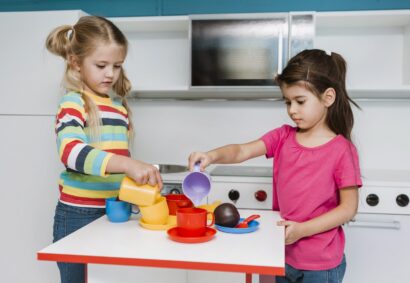
Practical Life materials help children learn everyday skills and develop independence. These activities are rooted in real life and build coordination and confidence.
Examples include:
- Dressing frames for buttoning and zipping
- Pouring activities with pitchers and trays
- Cleaning tools such as dusters and brushes
Practical Life materials support fine motor control, order, responsibility, and self-care. (École Montessori de Montréal)
2. Sensorial Materials
Sensorial materials refine the senses and help children make distinctions in sight, sound, touch, taste, and smell. These materials lay the foundation for future learning in language and mathematics.
Common sensorial materials include:
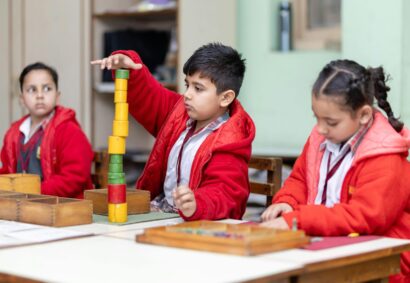
- Pink Tower for visual discrimination
- Knobbed Cylinders for tactile and size differentiation
- Color Tablets for matching and grading hues
- Sound Cylinders for auditory discrimination
These materials help children isolate specific sensory qualities and build awareness of the world around them.
3. Mathematics Materials
Montessori mathematics materials move from concrete to abstract concepts. Children learn number sense and mathematical operations through tangible tools that represent numerical ideas physically.
Examples include:
- Number Rods for understanding quantity and sequence
- Golden Beads for place value and arithmetic
- Bead Chains for counting and pattern work
This gradual progression supports deep mathematical understanding without memorization or rote learning.
4. Language Materials
Montessori language work supports phonetic awareness, vocabulary acquisition, reading, and writing through multisensory experiences.
Key language materials include:
- Sandpaper Letters that link sound and shape through touch
- Moveable Alphabet for forming words and sentences
- Metal Insets that refine pencil control and encourage writing practice
- Classified Cards to build vocabulary and comprehension
These tools strengthen both oral language and written literacy by combining sensory and cognitive learning.
5. Cultural Materials
Cultural materials expose children to geography, science, history, art, and music. These tools expand a child’s awareness of the world and encourage broader curiosity.
Examples of cultural materials include:
- Puzzle maps showing continents and oceans
- Land and water forms for geography exploration
- Botany cards for plant identification
- Timelines that introduce historical concepts
Cultural materials enrich learning by connecting academic concepts to real life.
How Children Work With Montessori Materials
In a Montessori environment children are introduced to materials by a trained guide with an initial demonstration. After this presentation, children are invited to explore the materials independently. They may return to the same activity multiple times to build mastery through repetition. As they work, children develop concentration, decision-making skills, and internal satisfaction from accomplishing tasks themselves. Materials are always returned to their specific place on open shelves, maintaining order and respect for the environment.
Benefits of Montessori Materials
Montessori materials serve multiple developmental goals, including:
Montessori Materials Compared to
Traditional Learning Tools
Montessori materials have features that set them apart from most traditional educational resources.
Montessori Materials
- Self-teaching with control of error
- Concrete experiences leading to abstract thinking
- Materials sequenced in progressive order
- Designed for independent exploration
Traditional Learning Tools
- Teacher-directed correction
- Abstract concepts introduced first
- Mixed skill levels in general resources
- Guided group instruction
Why Montessori Materials Matter at KS Montessori?
Montessori materials form the foundation of our approach to learning at KS Montessori. They support every child’s natural curiosity and allow learning to unfold organically through exploration, thought, and experience. By using purposefully designed materials, we encourage children to develop not just academic understanding, but also confidence, self-discipline, and a lifelong love for learning.