






 How to Improve Your Child’s Handwriting Before School
Handwriting is one of the first skills children begin developing long before they sit down to write their first sentence at school. From holding a crayon and drawing circles to tracing lines and eventually forming letters, every small activity helps prepare a child for writing.
If your child is getting ready for school and their handwriting isn’t quite where you expected it to be, don’t worry. Children develop fine motor skills at different speeds, and handwriting takes time, patience, and plenty of practice.
The good news is that you don’t need to turn your home into a classroom or make your child spend hours copying letters. In fact, young children often learn best when writing practice feels like play.
In this guide, we’ll look at simple and enjoyable ways you can help your child develop better handwriting skills before starting school.
Why Is Good Handwriting Important?
Handwriting is much more than making letters look neat.
When children write, they are using several skills at the same time. They need to control small hand movements, coordinate what they see with what their hands are doing, remember the shapes of letters, and eventually think about what they want to communicate.
Developing handwriting skills can help children improve:
Fine motor control
Hand-eye coordination
Pencil control
Concentration
Visual awareness
Letter recognition
Confidence
Early writing skills
However, it’s important to remember that “good handwriting” for a preschooler doesn’t mean perfect or beautifully formed letters.
At this age, the goal is to help children develop the physical strength, coordination, and confidence they need to become comfortable writers.
1. Start With Fine Motor Activities
Before expecting your child to write letters, help them strengthen the small muscles in their hands and fingers.
These muscles are essential for holding and controlling a pencil.
Simple activities you can try at home include:
Playing with playdough
Building with small blocks Using child-safe scissors
Threading beads onto a string
Completing puzzles
Picking up small objects with tweezers
Opening and closing buttons or zippers Using clothespin Tearing and pasting paper
Drawing with chalk
These activities may not look like handwriting practice, but they are preparing your child’s hands for the movements required for writing.
Try to make these activities part of your child’s everyday play rather than presenting them as exercises.
2. Encourage Drawing Every Day
Drawing is one of the easiest ways to prepare a child for handwriting.
Before children learn to form letters, they need to become comfortable making different types of lines and shapes.
Give your child plenty of opportunities to draw:
Straight lines
Curved lines
Zigzags
Circles
Spirals
Waves
Squares
Triangles
You can provide crayons, colored pencils, washable markers, chalk, or even paintbrushes.
Ask your child to draw a picture of their family, their favorite animal, or something they saw during the day. This encourages them to use their imagination while naturally developing pencil control.
The focus should be on enjoying the process, not creating a perfect picture.
3. Practice the Correct Pencil Grip—But Don’t Stress Too Much
Many parents worry about whether their child is holding a pencil correctly.
A comfortable and efficient pencil grip is helpful, but children may naturally experiment with different grips as their hand strength develops.
You can gently encourage your child to hold the pencil between the thumb and fingers, but avoid constantly correcting them or making writing frustrating.
A good approach is to provide short opportunities for drawing and writing and allow your child to gradually develop control.
If your child consistently struggles to hold a pencil comfortably, becomes tired very quickly, or experiences pain while writing, it may be worth discussing this with their teacher or an occupational therapist.
4. Let Your Child Write on Different Surfaces
Children don’t always have to sit at a desk with a pencil and notebook.
Changing the writing surface can make practice much more interesting.
Try:
Drawing with chalk on a board
Writing in sand
Tracing letters in flour
Drawing in shaving foam
Using a finger to write in rice
Painting letters with a brush
Writing on a large piece of paper on the floor
These activities allow children to explore letter shapes using different movements and sensory experiences.
For younger children, large movements are often easier than small, precise movements. Once they become more confident, you can gradually move toward smaller writing spaces.
5. Practice Pre-Writing Shapes
Before children can write letters, they need to learn how to control basic strokes and shapes.
You can practice:
Vertical lines
Horizontal lines
Diagonal lines
Crosses
Circles
Curves
Loops
Simple patterns
For example, you might draw a line of simple patterns and ask your child to copy them:
|||||
/////
~~~~~
ooooo
vvvvv
You can turn this into a fun game by creating roads for toy cars, waves for a boat, or paths for an animal to follow.
The more naturally children practice these movements, the more prepared they become for forming letters later.
6. Introduce Letters Slowly
Once your child is comfortable with basic lines and shapes, you can begin introducing letters.
Start with letters that are familiar and meaningful to your child, such as the letters in their name.
For example, if your child’s name is Sara, you might begin with S.
Let your child:
Look at the letter.
Say the letter’s sound.
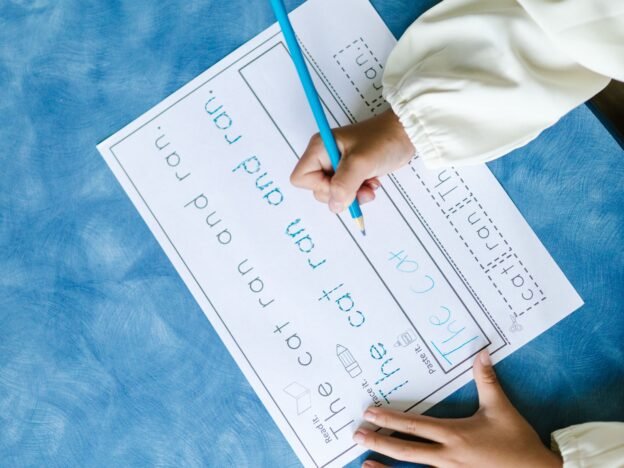
Trace the letter.
Try forming it independently.
Find the same letter in books or around the house.
Keep the practice short and positive.
You don’t need your child to write the alphabet perfectly in one sitting. A few minutes of focused practice is often more useful than a long session that leaves your child tired or frustrated.
7. Make Handwriting Part of Everyday Life
Children learn best when they understand that writing has a real purpose.
Instead of only using worksheets, look for opportunities to use writing naturally.
Your child can help you:
Write a shopping list
Make a birthday card
Label their toys
Write their name on artwork
Create a pretend restaurant menu
Make a list of favorite animals
Write a note to a family member
Help write a simple grocery list
When children see adults writing for real reasons, they begin to understand that writing is a useful way to communicate.
8. Choose the Right Writing Tools
The tools your child uses can make a difference.
For younger children, consider offering:
Thick crayons
Short pencil Chunky colored pencils Washable markers Chalk
These tools can be easier for small hands to control.
As your child’s fine motor skills improve, you can gradually introduce thinner pencils and more precise writing tools.
Don’t worry about buying lots of expensive stationery. A few comfortable, age-appropriate tools are enough.
9. Pay Attention to Posture and Seating
Your child’s body position can affect how comfortable writing feels.
When your child is writing, try to make sure:
Their feet are supported.
The table and chair are an appropriate height.
Their shoulders are relaxed.
The paper is positioned comfortably.
They have enough space to move their arm.
Children don’t need to sit perfectly still like adults. Young children naturally move while they work.
The goal is simply to create a comfortable environment where they can focus on the activity without unnecessary strain.
10. Don’t Compare Your Child With Other Children
This is perhaps one of the most important things to remember.
One child may write their name confidently at four, while another may still be developing pencil control at five. Both children can continue to make progress.
Children develop at different rates, and handwriting is influenced by many factors, including fine motor development, hand strength, coordination, attention, and previous experiences.
Instead of asking:
“Why can’t my child write like that child?”
Try asking:
“What is my child able to do now, and what is the next small step?”
Celebrate progress, even when it seems small.
If your child moves from scribbling to drawing recognizable shapes, that’s progress.
If they can draw a straight line more confidently than last month, that’s progress.
If they can write one letter independently, that’s progress too.
These small achievements build the foundation for future learning.
11. Keep Practice Short and Positive
Young children have short attention spans, so handwriting practice doesn’t need to take a long time.
Try starting with 5 to 10 minutes a day.
You might spend a few minutes drawing patterns, followed by a short letter activity and then finish with free drawing.
If your child becomes frustrated, stop and try again another day.
The goal is to help your child associate writing with curiosity and enjoyment—not pressure.
A child who enjoys learning is more likely to want to practice.
12. Read Together, Too
Reading and handwriting may seem like separate skills, but they support each other as children develop early literacy.
When you read books together, your child is exposed to letters, words, and print.
Point out interesting letters occasionally. Talk about the first letter of your child’s name. Let your child notice words on signs, food packaging, or storybooks.
You don’t have to turn every reading session into a lesson.
Simply creating a home environment where books and written language are part of everyday life can help your child become more comfortable with print.
A Simple 10-Minute Handwriting Routine
If you’re looking for a simple routine to follow at home, try this:
2 Minutes – Finger Warm-Up
Use playdough, squeeze a soft ball, or do simple finger movements.
2 Minutes – Pre-Writing Patterns
Practice lines, circles, waves, or zigzags.
3 Minutes – Letter Practice
Work on one or two letters. Trace first, then try writing independently.
3 Minutes – Free Drawing
Let your child draw anything they like and encourage them to tell you about their picture.
Remember, this routine is only a guide. Some days your child may want to draw for 10 minutes. Other days they may be more interested in playdough.
That’s perfectly fine.
What If My Child Still Struggles With Handwriting?
Some children need more time to develop the skills required for writing.
If your child consistently finds handwriting very difficult, you may notice things such as:
Becoming extremely tired after a short writing activity
Avoiding drawing or writing altogether
Having significant difficulty controlling a pencil
Complaining of pain or discomfort
Struggling with tasks that require fine motor skills
Becoming unusually frustrated during simple writing activities
If you have ongoing concerns, speak with your child’s teacher or pediatrician. They can help you understand whether your child’s development is progressing as expected and whether additional support could be helpful.
Early support can make a positive difference, so there is no need to wait if you have genuine concerns.
Final Thoughts
Preparing your child for school isn’t about making them perfect at writing before their first day.
It’s about giving them opportunities to develop the skills, confidence, and independence they will need as they begin their learning journey.
Give your child time to draw. Let them play with playdough. Encourage them to explore letters. Read together. Let them write their name on their artwork. Most importantly, keep learning enjoyable.
The best handwriting practice for a young child is often the kind that doesn’t feel like practice at all.
At Kiran Saif Montessori, we believe children learn best when they are encouraged to explore, create, and learn at their own pace. With the right support and plenty of opportunities to practice, your child’s little hands can gradually develop the skills they need to become confident writers.
Every line, every shape, and every scribble is a small step toward writing. 🌱