







Before a child can understand that 10 is greater than 1, they need to feel it. They need to hold it, carry it, line it up, and see it take up more space in the room. This is the quiet but powerful logic behind the Montessori Red Rods — one of the earliest and most beautiful math materials in the Montessori classroom.
Long before numbers are introduced, long before counting begins, the Red Rods give children a direct, physical, sensory experience of length and quantity. They are the foundation upon which all future mathematical understanding is built — and in this post, we explore exactly how and why.
Whether you are a parent curious about Montessori math, an educator deepening your understanding of the materials, or someone looking to support early numeracy at home, this guide is for you.
What Are Montessori Red/long Rods?
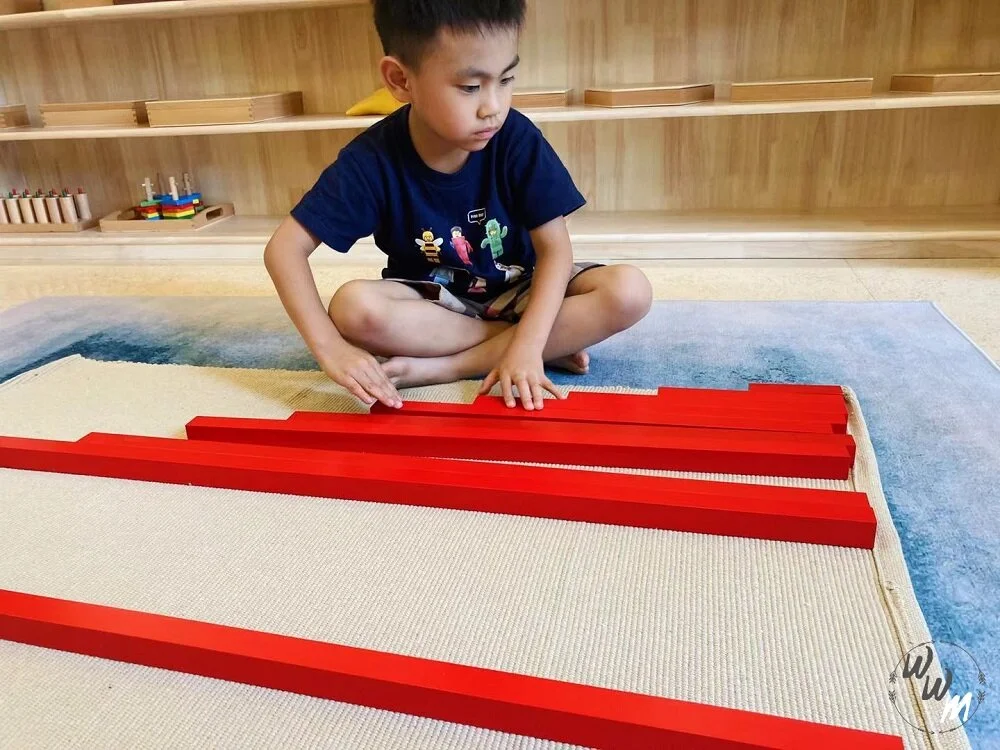
The Montessori Red Rods are a set of ten smooth wooden rods, each painted red, that vary in length from 10 centimetres to 1 metre. The rods increase in length by equal increments of 10 centimetres — so the shortest rod is 10 cm, the next is 20 cm, the next 30 cm, and so on up to the longest rod at 100 cm (one metre). The width and height of every rod is identical — only the length changes.
This elegant, uniform design is entirely intentional. Because every variable except length is controlled, the child’s attention is drawn naturally and exclusively to the one concept the material is designed to teach: length — and by extension, the mathematical idea that quantities differ in measurable, predictable ways.
Design principle: In Montessori, each material isolates a single concept. The Red Rods isolate length — nothing else changes, so nothing else distracts.
Where Do Red Rods Fit in the Montessori Curriculum?
The Red Rods belong to the Sensorial area of the Montessori classroom — the section dedicated to refining the child’s five senses and building the perceptual foundations of all later academic learning. They are typically introduced between the ages of two and a half and three and a half, before any formal numeracy work begins.
The Red Rods sit alongside other beloved sensorial materials — the Pink Tower, the Brown Stair, the Colour Tablets, the Sound Cylinders — each of which isolates a different quality: size, dimension, colour, sound. Together, these materials build what Montessori called the mathematical mind — a mind naturally attuned to precision, order, pattern, and measurement.The Red Rods are also the direct sensorial precursor to the Number Rods — the material through which quantities and numerals are first formally linked. A child who has worked thoroughly with the Red Rods arrives at the Number Rods with a fully prepared body and mind
What Do Red Rods Actually Teach?
At first glance, the Red Rods might seem too simple — just ten rods of different lengths. But in the hands and mind of a young child, they quietly lay down some of the most important mathematical foundations of all:
- The Concept of Length
This seems obvious — but it is not. Many children arrive at school able to recite numbers without understanding what quantity really means. The Red Rods make length physical and real. The child does not learn that the longest rod is ‘big’ in an abstract sense — they carry it across the room, feel its weight and unwieldiness, and understand bigness in their body.
- Comparative Language and Reasoning
Working with the Red Rods naturally invites the language of comparison: longer, shorter, longest, shortest, the same as, more than, less than. These are not just vocabulary words — they are the building blocks of mathematical reasoning. A child who can confidently compare, order, and describe lengths is thinking mathematically even before they have touched a number.
- Seriation — Ordering by Gradation
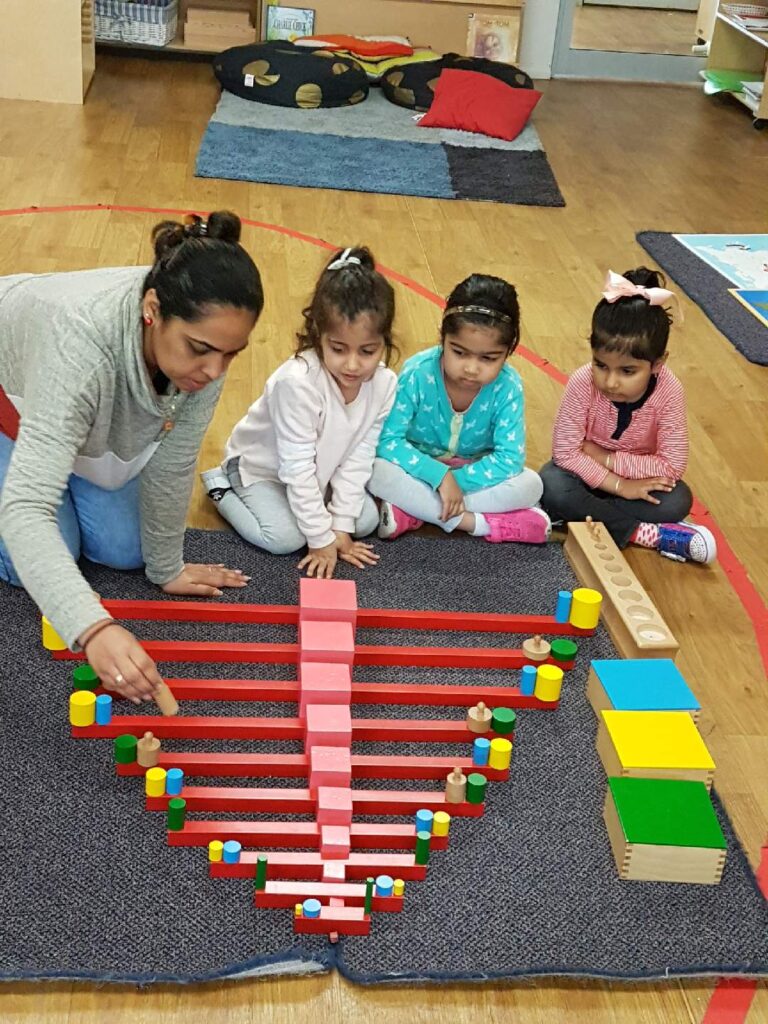
When a child arranges the ten rods in order from shortest to longest (or longest to shortest), they are practising seriation — the ability to arrange objects along a continuum. Seriation is a foundational cognitive skill identified by Jean Piaget as essential for later mathematical thinking, particularly for understanding number sequences and the number line.
- The Decimal System — A Sensory Preview
The Red Rods increase in increments of exactly 10 centimetres. Without yet knowing the word ‘decimal’, the child who works deeply with the Red Rods is absorbing the structure of the base-10 system through their hands. This embodied knowledge will surface powerfully when the decimal system is formally introduced later.
- Early Measurement Concepts
Children begin to understand that the longest rod is exactly ten times the length of the shortest — a discovery they can make by placing ten of the smallest rods end to end. This early, concrete experience of multiplication (ten groups of one) is one of the earliest seeds of multiplicative thinking.
- Concentration and Order
Working with the Red Rods requires the child to carry each rod carefully (some are heavy and long), arrange them precisely, and return them to the mat or shelf in order. This builds concentration, physical coordination, and the Montessori quality of normalisation — that calm, focused, purposeful engagement that is the hallmark of a prepared child.
How to Present the Red Rods: A Step-by-Step Guide
The Red Rods are introduced through a simple, three-stage lesson that follows the natural Montessori presentation method. As with all Montessori lessons, the emphasis is on minimal language, clear demonstration, and allowing the child to discover rather than be told.
Before You Begin
- Choose a large floor mat or a clear area of floor — the rods need space
- Bring the rods one at a time from the shelf to the mat, laying them randomly
- Sit beside the child, not across from them
Stage One — Exploration
Before imposing any structure, allow the child to freely handle the rods. Let them carry them, feel the difference in weight, notice which is long and which is short. This free exploration is not wasted time — it is essential preparation.
Stage Two — Ordering
Begin with just three rods — the shortest, the longest, and one in the middle. Demonstrate finding the longest: run your hand along several rods, pause, and place the longest at the top of the mat. Then find the next longest and place it below. Invite the child to continue. Gradually expand to all ten rods as the child gains confidence.
Stage Three — Language and Three-Period Lesson
Once the child can order the rods reliably, introduce comparative language using the Three-Period Lesson: ‘This is the longest rod. This is the shortest rod. Show me the longest. Show me the shortest. Which is this?’ Keep the language simple and the pace relaxed.
Teacher tip: If the child makes an error in ordering, do not correct immediately. Allow them to notice for themselves — the material’s control of error lies in the visual staircase pattern. If it looks right, it is right.
Red Rods and Number Rods: The Natural Progression
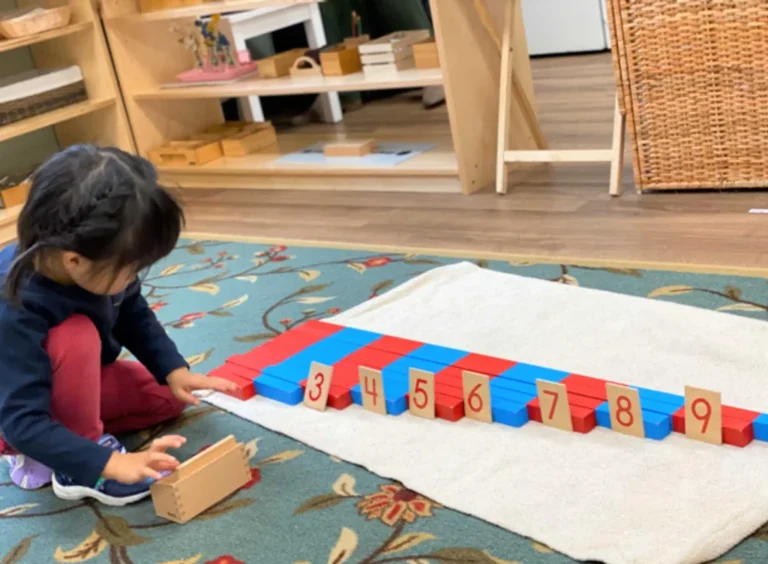
Once a child has fully internalised the Red Rods — can order all ten confidently and use comparative language naturally — they are ready for the Number Rods. The Number Rods are identical in size to the Red Rods but are painted in alternating red and blue sections, each section representing one unit. The shortest rod has one red section (quantity 1), the next has one red and one blue (quantity 2), and so on.
Because the child already knows these rods in their body — knows how long each one is, how it feels to carry it, how it fits in the sequence — the introduction of number is not a leap into the unknown. It is a label being placed on something deeply familiar. This is the Montessori genius: the abstract is always anchored in the concrete.
The Full Montessori Early Math Journey
The Red Rods are the beginning of a beautifully sequenced mathematical journey. Here is how the materials flow from one to the next, each building on what came before:
- Red Rods → sensorial experience of length and seriation
- Number Rods → quantities 1–10 named and counted
- Sandpaper Numerals → written symbols for each quantity
- Spindle Boxes → zero introduced; loose objects counted into compartments
- Counter Cards and Counters → odd and even numbers explored
- Golden Bead Material → the decimal system in physical form
Each step prepares the child for the next. No child is hurried forward before they are ready, and no concept is introduced in the abstract before it has been lived in the concrete.
Shop Our Montessori Early Maths Materials
If you would like to support your child’s mathematical journey at home or in your classroom, we have a carefully selected range of authentic Montessori math materials available at KS Montessori. Each one is crafted to the highest standards and aligned with the genuine Montessori sequence:
- Long Rods (Red Rods) — The classic Montessori sensorial introduction to length. Ten beautifully crafted red rods that build the foundations of measurement, seriation, and the decimal system — all through the joy of hands-on exploration.
- Number Rods — The natural next step after the Red Rods. Identical in size but colour-coded in red and blue units, these rods make quantities 1–10 visible, tangible, and deeply meaningful — the perfect bridge between concrete experience and abstract number.
- Counter Cards and Counters — A beautifully simple material for exploring the quantities 1–10, introducing the concept of odd and even numbers, and building one-to-one correspondence. Children physically place counters beneath number cards — arithmetic made tactile.
- Spindle Boxes — One of the most important materials in early numeracy — the Spindle Boxes introduce the concept of zero for the first time, alongside a concrete experience of loose quantity. Children count and place real spindles into numbered compartments.
Each of these materials is designed to work in sequence, supporting your child step-by-step from their first sensory experience of quantity all the way to a confident, joyful understanding of number.
Frequently Asked Questions About Red/long Rods
At what age should I introduce Red Rods?
Most children are ready to begin working with Red Rods between two and a half and three and a half years of age. However, readiness matters more than age. A child who can carry objects carefully, concentrate on a task for several minutes, and is showing curiosity about size and order is ready — regardless of their exact age.
Do Red Rods need to be used in a Montessori classroom, or can I use them at home?
Red Rods work beautifully at home, provided you have sufficient floor space (the longest rod is one metre) and introduce them in the spirit of the Montessori approach — through demonstration, not instruction; through invitation, not insistence. A calm, unhurried environment where the child can choose when to work with the material is all that is required.
How are Red Rods different from the Pink Tower and Brown Stair?
The Pink Tower isolates the dimension of size (volume — small to large in three dimensions). The
Brown Stair isolates thickness (two dimensions — thin to thick). The Red Rods isolate length (one dimension — short to long). Together, these three materials give the child a comprehensive sensorial understanding of three-dimensional space. They are often used in combination as the child advances.
How long should a session with Red Rods last?
Follow the child’s lead entirely. Some children will work with the rods for five minutes; others will spend thirty minutes ordering, reordering, and exploring. Both are perfect. Never interrupt a child who is deeply concentrated with Montessori material — that concentration is the most valuable thing of all.
Conclusion: When Mathematics Begins in the Body
The Montessori Red Rods remind us that the best mathematical education begins long before pencil meets paper — long before a child can name a single number. It begins in the body: in the feeling of carrying a heavy rod across the room, in the satisfaction of placing each piece in its correct sequence, in the quiet discovery that some things are longer, some shorter, and that this difference can be ordered, measured, and understood.
This is the gift of Montessori mathematics. Not sums to be memorised, but truths to be discovered. Not numbers to be drilled, but quantities to be felt. And it all begins with ten red rods and a child who is ready to explore.
Explore our full range of Montessori early maths materials at KS Montessori and give your child the most powerful beginning to their mathematical journey.
Browse all Montessori math materials: ksmontessori.com.pk
Tags: Montessori Red Rods, Early Math, Number Rods, Montessori Sensorial, Math Foundations, Child Development, Montessori Materials, Early Numeracy